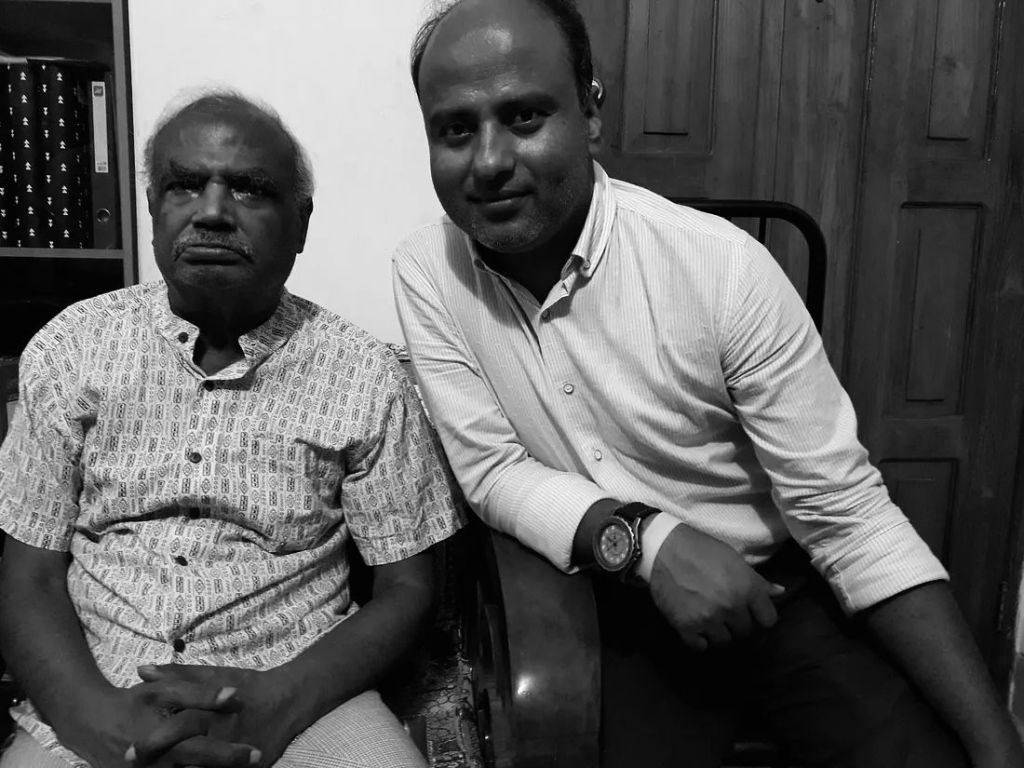
Renowned political scientist and national professor Talukder Maniruzzaman can no longer write and can hardly speak clearly. Born Sirajganj in 1938, Talukder Maniruzzaman graduated from Dhaka University in 1961 and was subsequently awarded a Commonwealth Scholarship. He secured his PhD degree from Queen’s University, Kingston, Canada. He joined Rajshahi University in 1966 as a senior lecturer at the Department of Political Science and switched over to Dhaka University as a professor in 1974. Prof. Maniruzzaman recently spoke, albeit with difficulty, to Taib Ahmed of South Asian Monitor, about Bangladesh, politics and the way ahead.
Read this in Bengali (https://bn.southasianmonitor.com/2017/12/12/20079)
SAM: What would you, as a political scientist, say about current state of politics in the country?
TM: Very disappointing. I find nothing to be optimistic. All the state organs have fallen apart.
SAM: Do you see any scope for fair elections slated for late 2018?
TM: The elections seem to be uncertain.
SAM: The election commission has begun talks with the political parties. Will it help earn confidence of all political parties?
TM: I don’t think that this election commission will be able to create a congenial atmosphere for a free and fair election.
SAM: Why?
TM: Both the rival political camps are intransigent. I don’t think that the ruling Bangladesh Awami League (AL) would hold a participatory elections. AL would not hold an election keeping Sheikh Hasina out of the power structure. On the other hand, Bangladesh Nationalist Party (BNP) would not join the elections with Sheikh Hasina in power. I don’t find any scope for reaching a consensus between the two major parties. I see the possibility of a lopsided election once again.
SAM: Then what would BNP do in that context?
TM: The BNP would try to wage street agitation.
SAM: How far is there the possibility of BNP waging successful street agitation as the government may then undertake a tough stance against the BNP?
TM: It would depend on what type of strategies the BNP would take against the government strategy and would also depend on what type of action the government will take to contain the movement.
SAM: It is assumed that there is an international pressure for a free and fair election.
TM: There will be pressure from the international community for a free and fair election, but it doesn’t seem that the AL government will accept that. Besides, neighbouring India will finally remain with the AL. The United States and European Union and others will mount pressure, but they will not wage a war against the government.
SAM: India has not extended its support to Bangladesh on the Rohingya issue. How do you see this?
TM: India is not siding with Bangladesh just because Rohingyas are Muslims. The Kashmir issue is always whirling in its [India’s] head. Muslim identity of Rohingyas seems to be the biggest crime for them. China is always in a kind of fear centring on the Muslims of Xinxiang. China, Russia and India have stood together just because it is a Muslim issue. If India does not support AL over the issue of Rohingya, it will side with the AL in the issue of “BNP-versus-AL”. Finally, India will remain with AL.
SAM: You spoke of BNP’s street agitation. The party had waged a sturdy street agitation in 2014, but all to no avail.
TM: For all practical purposes, the autocratic regime does not seem to come to an end shortly.
SAM: You mean Sheikh Hasina will continue to rule for more time.
TM: It seems so.
SAM: Where would the country go if a fair election is not held?
TM: We’ll have to keep in view that both the big parties enjoy huge popular support. The country will plunge into a chaos if the next elections are not held in a free and fair manner. Then there is a possibility of bloodshed.
SAM: Against this backdrop, do you find any scope of military intervention?
TM: It does not seem that there will be a military intervention, because none of the political parties wants so.
SAM: Are you saying that Bangladesh’s democratic process has fallen apart?
TM: Bangladesh should hold elections with a shorter interval. The tenure of a parliament should be of maximum three years. Then a context of changing power through democratic means could be ensured.
SAM: You said you don’t find an end to the autocratic regime. Then who will come after Sheikh Hasina?
TM: Joy will come after Hasina. And Tarique will take the helm of Khaleda’s party.
SAM: How do you see the state of country’s security amidst political uncertainty?
TM: In all respects, we are not being able to protect our sovereignty. A country like Myanmar is now brandishing its might.
SAM: Why and how did this happen?
TM: We cannot maintain equal or balanced relations with all other states. Being a small state, we are as if entering the belly of a big shark. Our neighbours are behaving with us like a superpower.
SAM: Many think that Bangladesh has been a playground of India and China to show their might. What do you think?
TM: That’s inevitable. I think the presence of United States in this region will help defuse the China-India rivalry.
SAM: What is the future Bangladesh?
TM: The youth will define the future. They dream of a new future. They will dream of building a Sonar Bangla.
SAM: Why do you think Bangladesh cannot get out of political crisis even some 45 years into its liberation?
TM: It is because of the clash between ‘Bengali nationalism’ and ‘Bangladeshi nationalism’. The country’s politics has remained sharply polarised for long over the issue of nationalism. And it will continue to rage in the country’s politics.
SAM: What will be your suggestion for the youth? Which one of the nationalisms should they pursue to steer the country forward?
TM: Bangladeshi nationalism.
SAM: Why?
TM: Bangladeshi nationalism is an inclusive idea, but Bengali nationalism is an exclusive one. The linguistic nationalism, Bengali nationalism, speaks only of Bengali-speaking people, excluding people from all other linguistic groups. On the other hand, Bangladeshi nationalism is a territorial nationalism. It speaks of all types of people — no matter from which creed, religion or ethnicity they have come — who belong to the territory. More than that, Bangladesh is a Muslim majority country while Bengali nationalism is more lenient towards Hindu culture. So, Bengali culture contradicts many of the cultures of Muslims. It can in no way bring peace in the society.
SAM: What is your expectation at this mature stage of your life?
TM: I always want, think and wish: let Bangladesh prosper.
SAM: Thank you
TM: Thank you
The article was originally published in South Asian Monitor on 12 December 2017, at https://southasianmonitor.com/2017/12/12/political-crisis-rooted-clash-nationalisms-talukder-maniruzzaman/
And it can be found in the following link: https://web.archive.org/web/20180120075546/https://southasianmonitor.com/2017/12/12/political-crisis-rooted-clash-nationalisms-talukder-maniruzzaman/

 Abu Taib Ahmed
Leave a comment